In short
- A pharmacy POS is a till built around batches and expiry dates: it records the batch and expiry of every delivery, sells the batch that expires first, warns before stock expires and stops or asks before an expired item is sold.
- At the counter it must find medicines fast by name or barcode, handle strips, boxes and bottles as different units, and keep selling when the power or internet goes.
- Behind the counter it should suggest what to reorder from real sales, keep supplier orders and returns, and show the value of stock that is about to expire so it can be sold or returned in time.
- For the NMRA it should keep the prescription of every Schedule IIB and III sale with the pharmacist who handed it over, a running Schedule III register, the daily fridge temperatures and a quarantine for expired stock, and warn when a price is above the gazetted MRP.
Why a pharmacy needs more than a shop till
A grocery can lose a few packets of biscuits to expiry; a pharmacy cannot afford to sell an expired medicine, or to lose money on boxes that expire on the shelf. The difference is the batch: two boxes of the same medicine can have different batch numbers and different expiry dates. A pharmacy POS records them at the door, sells them in the right order and tells you in time when something is going to expire.
Batches and expiry dates: how it should work
- When stock arrives, the pharmacist enters (or scans) the batch number and expiry date of each line on the supplier's invoice.
- When it is sold, the POS takes it from the batch that expires first (FEFO, first expiry first out), so older stock leaves the shelf first.
- Before it expires, the POS lists what will expire in the next weeks with its value, so it can be sold, moved to another branch or returned to the supplier.
- If someone tries to sell an expired item, the till stops or asks a manager to approve it, and the sale records who allowed it.
- When stock expires, it is written off with a reason, so the stock value and the accounts stay true.
A fast, accurate counter
- Find any medicine in a second: scan the barcode, or type a few letters of the name.
- Units and packs: buy by the box, sell by the strip or tablet card, with stock right in both.
- Customers and credit: regular customers, doctors' clinics or estates on account, with a limit and a monthly statement.
- Payments: cash with change, card, LankaQR and split payments, all counted separately at closing.
- Offline: the till keeps selling, printing and taking payments during a power or internet cut.
Stock, suppliers and reorders
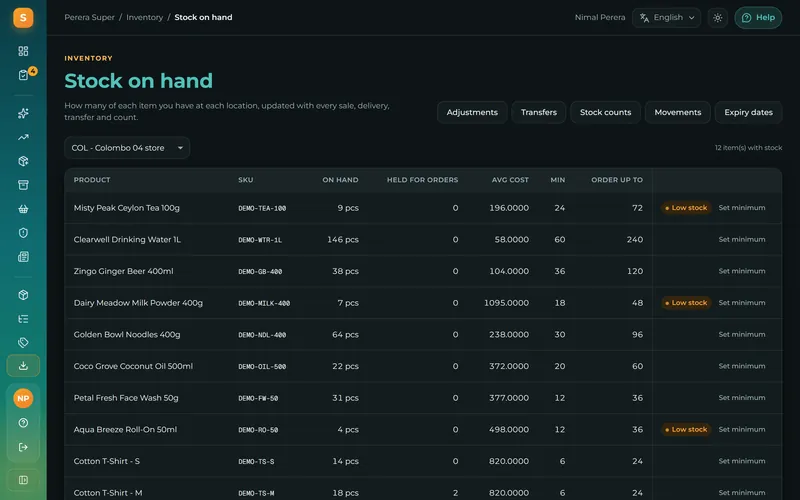
Pharmacies stock thousands of lines from many suppliers. A good POS suggests what to reorder from what really sells (not from guesses), sends purchase orders to suppliers, records what arrived with its batch and expiry, and handles supplier returns for near-expiry or damaged stock. Stock counts by scanning, and transfers between branches, keep the numbers honest.
| Need | What to look for |
|---|---|
| Batch and expiry | Recorded at receipt, FEFO when selling, alerts before expiry |
| Expired items | Blocked or approval needed, with a record of who allowed it |
| Write-offs | Expired or damaged stock written off with a reason |
| Units | Box, strip, tablet; buy in one, sell in another |
| Reorders | Suggestions from real sales, purchase orders, supplier returns |
| Reliability | Works offline during power and internet cuts |
| Prescriptions | IIB and III need the prescription and a pharmacist, with labels |
| NMRA registers | Schedule III register, fridge log, quarantine |
| MRP | Prices above the gazetted MRP warned about and listed |
| Languages | Sinhala, Tamil and English for staff, receipts and labels |
Prescriptions, labels and the NMRA's registers
The NMRA schedules medicines: I general sale, IIA pharmacy, IIB prescription only, III narcotics and psychotropics, and only a pharmacist may hand over Schedule II and III medicines. A pharmacy POS should know each medicine's schedule and act on it:
- At the counter, a IIB or III medicine asks for the prescription (patient, doctor and SLMC number, date, a photo) and a pharmacist before payment, even offline.
- Dispensing labels print the dose and directions in large letters in the patient's language: Sinhala, Tamil or English.
- A prescription register is searchable and printable, and lists sales that needed a prescription but had none.
- The Schedule III register shows every movement of each controlled medicine, by batch, with a running balance and who each sale went to.
- The fridge log records the medicine fridge's temperature every day (2 to 8 °C) with what was done when it was out of range.
- Quarantine takes expired, recalled or damaged stock off sale in one step; a batch's history shows who bought the rest, for a recall.
- MRP: a price above the gazetted maximum retail price is warned about and listed to fix, and the gazette's new MRPs upload as a list.
Check with your pharmacist and the NMRA which records your pharmacy must keep and for how long; the POS keeps them, the pharmacist stays responsible for them.
Sevo Biz App for pharmacies
Sevo Biz App has a Pharmacy kind of business, in every plan. Medicines carry their generic name, strength, form, NMRA schedule and MRP; the till finds them by brand or generic name and offers another brand when one is out of stock. Schedule IIB and III sales take the prescription and a pharmacist's PIN, labels print in Sinhala, Tamil or English, and the Prescriptions and Schedule III registers, the fridge log, quarantine and the gazette's MRP list are built in, beside batches and expiry, first-expiry-first-out, packs and units, supplier orders, offline selling and accounts. See Sevo for pharmacies. Plans start at Rs 900 a month; every feature is free for 14 days: start a free trial.
Questions and answers
What is FEFO in a pharmacy?
FEFO means first expiry, first out: when a medicine is sold, the stock from the batch that expires soonest leaves first. A pharmacy POS applies it automatically once batches and expiry dates are recorded at receipt.
Can a POS stop the sale of expired medicine?
Yes. A pharmacy POS knows each batch's expiry date and can block the sale of an expired item or require a manager's approval, recording who allowed it.
What is the best POS for a pharmacy in Sri Lanka?
One that tracks batches and expiry dates, sells first-expiry-first-out, warns before stock expires, handles boxes and strips, suggests reorders and keeps selling during power cuts. Test it with your own medicines and supplier invoices.
Does a pharmacy POS handle prescriptions?
A pharmacy POS should. In Sevo Biz App a Schedule IIB or III medicine asks for the prescription (patient, doctor, SLMC number, photo) and a pharmacist's PIN before payment, prints dispensing labels, and keeps a searchable prescription register and each patient's medication record.
What is the Schedule III register?
A running record of each narcotic and psychotropic medicine: what was received, dispensed (on whose prescription, by which pharmacist), returned, written off and counted, with the balance after each movement, for an NMRA inspection.